


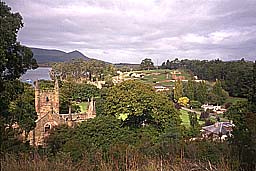
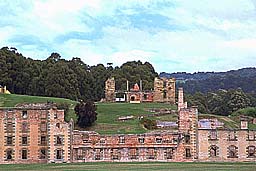
Established in 1830 to contain difficult prisoners, the settlement at Port Arhur was to become virtually self-sufficient, with inmates producing cut timber for ship building, bricks, nails, garden tiles, flour, footwear and clothing.
 The penal system was based on the "Model Prison" created
in London. Increasingly in use from 1850 it worked on the principle
of isolation of prisoners rather than physical disciple. The inmates
lived and worked in total silence and to prevent recognition,
head-masks were worn when the prisoners had
The penal system was based on the "Model Prison" created
in London. Increasingly in use from 1850 it worked on the principle
of isolation of prisoners rather than physical disciple. The inmates
lived and worked in total silence and to prevent recognition,
head-masks were worn when the prisoners had 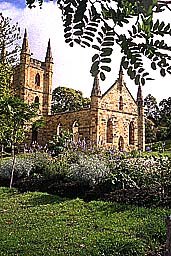 contact with each other. Although aimed at reforming the convicts,
it is doubtful that this form of punishment was successful.
contact with each other. Although aimed at reforming the convicts,
it is doubtful that this form of punishment was successful.
The transportation program proved useful to Britain in that it
enabled them to relieve the servere overcrowding of their goals
by banishing offenders to Australia for even petty theft like
stealing a loaf of bread. Most convicts were assigned to free
settlers and progressed after good conduct to gain a ticket-of-leave.
 The could then earn a conditional pardon and finally a full pardon.
The total number of persons transported to Australia was approximately
164,000. Around 25,000 of these were women, 123,000 were single
and the average age was 26 years.
The could then earn a conditional pardon and finally a full pardon.
The total number of persons transported to Australia was approximately
164,000. Around 25,000 of these were women, 123,000 were single
and the average age was 26 years.
The tiny Isle of the Dead served as the official graveyard. Covering barely an acre in area, between 1831 to 1877 nearly 2,000 convicts and free persons were buried there. Today regular ferry trips are available to view the surviving headstones.
In all 12,000 prisoners were to pass through Port Arthur until
it was closed in 1877 after the transportation of convicts ended.
Following a series of bushfires the buildings fell into decay
and are still being gradually restored.

