


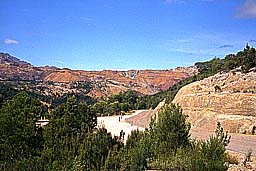
The final, winding descent into Queenstown from the Lyell Highway is an unforgettable experience. With deep eroded gullies and naked multicolored hills, there is no escaping the fact that this is a mining town, and that the destruction of the surrounding area is a direct result of this industry.
In 1881, the discovery of alluvial gold in the Queen River valley first brought prospectors to the area. Two years later, mining began on the rich Mt Lyell desposits, and for nearly a decade miners extracted a few ounces of gold a day and ignored the mountain's rich copper reserves. In 1891, however, the Mt Lyell Mining Company began to concentrate on the copper and it soon became the most profitable mineral on the west coast.
 In 1899, the company built a 35-km railway between Queenstown
and Strahan to transport copper, and passengers,
to the coast. It traversed spectacular terrain (48 bridges were
built) and was so steep in some sections that the rack and pinion
system had so be used to assist the two steam engines hauling
the train.
In 1899, the company built a 35-km railway between Queenstown
and Strahan to transport copper, and passengers,
to the coast. It traversed spectacular terrain (48 bridges were
built) and was so steep in some sections that the rack and pinion
system had so be used to assist the two steam engines hauling
the train.
At the turn of the century, Queenstown had a population of 5051 and was the third largest town in Tasmania. It had 14 hotels, there were 28 mining companies working the Mt Lyell deposits, and 11 furnaces were involved in the smelting process. The Mt Lyell Mining & Railway Company eventually acquired most of the mines or leases, and since 1933 has worked the area without a rival.
After 20 years of mining, the rainforested hills around Queenstown had been stripped bare: three million tones of timber had been felled to feed the furnaces. By 1900, uncontrolled pollution from the copper smelters was killing any vegetation that had not already been cut down, and bushfires raged through the hills every summer, fuelled by the sulphur-impregnated soils and dead stumps, until there was no regrowth left at all.
Today, mining is still Queenstown's major industry but there are
concerns that the one deposits my be dwindling. Recently, attempts
have been made to reforest parts of Queeenstown's famous lunar
landscape but, because tourism is another important source of
income, and the denudation is exactly what visitors come to see,
a question mark hangs over the continuation of such projects.

