


Strahan, 40 km from Queenstown on Macquarie Harbour, is the only town on this
rugged and dangerous coast. Though only a shadow of its former self, the town is
rich in convict, logging and mining history.
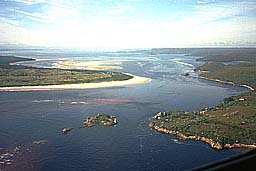
Treacherous seas, the lack of natural harbours and high rainfall discouraged early settlement of the region until Macquarie Harbour was discovered by sailors searching for athe source of the Huon pine that frequently washed up on the southern beaches.
In those days, the area was totally inaccessible by land and very difficult to reach by sea, and in 1821 these dubious assets prompted the establishment of the penal settlement on Sarah Island, in the harbour. Its main function was to isolate the worse of the colony's convicts and to use their muscle to harvest the huge stands of Huon pine. The convicts worked upriver 12 hours a day, often in leg irons, felling the pines and rafting them back to the island's saw-pits where they were used to build ships and furniture.
With its barbaric treatment of prisoners, Sarah Island became one of Australia's most notorious penal settlements. The most dreaded punishment was confinement on tiny Grummel Island, where up to 40 convicts at a time were held in appalling conditions on what was little more than a windswep rock - for some death was a welcome release.
 Sarah Island appeared in Marcus Clarke's graphic novel about convict life "For the Term of his
Natural Life". In 1834, however, after the establishment of the 'escape-proof' penal settlement
at Port Arthur, Sarah Island was abandoned.
Sarah Island appeared in Marcus Clarke's graphic novel about convict life "For the Term of his
Natural Life". In 1834, however, after the establishment of the 'escape-proof' penal settlement
at Port Arthur, Sarah Island was abandoned.
As the Port for Queenstown, Strahan reached its peak of prosperity with the westcoast mining boom, and the completion of the Mt Lyel Mining Company's railway line in the 1890s. At the turn of the century, it was a bustling centre with a population of 2000 Steamers operated regularly between Strahan and Hobart, Launceston and Melbourne carrying copper, gold, silver, lead, timber and passengers. The closure of many of the west-coast mines and the opening of the Emu Bay Railway from Zeehan to Burnie led to the decline of Strahan as a port.
These days, Strahan is a charming seaside town which draws visitors in droves for cruises on the Gordon River and scenic flights over the area. The council was just approved a large wharf development scheme which, if it goes ahead, will bring some unfortunate changes to this as yes unspoiled fishing town.

