


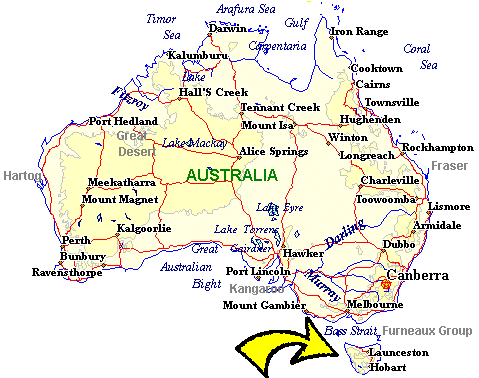
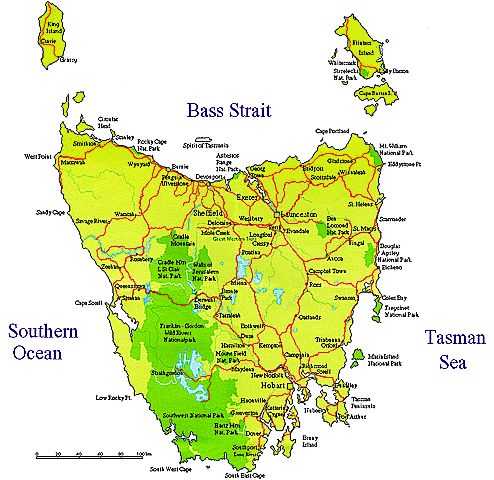
 Tasmania
is Australia's only island state and this has been a major influence
on its historical, cultural and geographical development. Being
an island, it was considered an ideal location for penal settlements,
and convicts who reoffended on the Australian mainland were shipped
there. Its isolation has also helped preserve its rich colonial
heritage, and ensure that most of the state's wilderness areas
(with a few notable exceptions) have remained relatively unspoiled.
Tasmania
is Australia's only island state and this has been a major influence
on its historical, cultural and geographical development. Being
an island, it was considered an ideal location for penal settlements,
and convicts who reoffended on the Australian mainland were shipped
there. Its isolation has also helped preserve its rich colonial
heritage, and ensure that most of the state's wilderness areas
(with a few notable exceptions) have remained relatively unspoiled.
The first European to see Tasmania was the famous Dutch navigator Abel Tasman who arrived in 1642 and called it Van Diemen's Land, after the Governor of the Dutch East Indies. In the 18th century, Tasmania was sighted and visited by a series of famous European seamen, including Captain Tobias Furneaux, James Cook and William Bligh, all of whom believed it to be part of the Australian mainland.
European contact with the Tasmanian coast became more frequent after the soldiers and convicts of the First Fleet settled at Sydney Cove in 1788, manly because ships heading to the colony of New South Wales from the west had to sail around the island.
In 1798 Lieutenant Matthew Flinders circumnavigated Van Diemen's Land and proved that it was an island. He named the rough stretch of sea between the island and the mainland Bass Strait, after George Bass, the ship's surgeon. The discovery of Bass Strait shortened the journey to Sydney form India or the Cape of Good Hope by a week.

In the late 1790s Governor King of New South Wales decided to
establish a second colony in Australia, south of Sydney Cove.
Port Phillip Bay in Victoria was considered, but a site on the
Derwent River in Tasmania was finally chosen and in 1804 Hobart Town
was established. Although convicts were sent with the first settlers,
penal settlements were not built until later; at Macquarie Harbor
in 1821, Maira Island in 1825 and at Port Aarthur
in 1832. For more than three decades, Van Diemen's Land was the
most feared destination for British convicts.
In 1856 transportation to Van Diemen's Land was abolished and its first parliament elected. Also in 1856, in an effort to escape the stigma of its dreadful penal reputation, Van Diemen's Land became officially known as Tasmania, after its first European discoverer.
Reminders of the island's convict days and early history are everywhere.
There are the penal settlement ruins at Port Arthur,
many convict-built bridges, a host of beautifully preserved Georgian
sandstone buildings and more than 20 historical towns or villages
classified by the National Trust.
Tasmania is also renowned worldwide for its pristine wilderness
areas and, during the last twenty or so years, has played an essential
role in world environmental and conservation issues.
Since European settlement, the story of Australia's Aborigines
has not been a happy one and nowhere has it been more tragic than
in Tasmania.
Tasmania's Aborigines became separated from the mainland over
10,000 years ago when rising ocean levels, caused by the thawing
of the last ice age, cut the state off from the rest of the country.
From the time on their culture diverged from that of the mainland
population. They lived by hunting, fishing and gathering, sheltered
in bark lentos and, despite Tasmania's cold weather, went naked
apart from a coating of grease and charcoal. Their society was
based on sharing and exchange - a concept the European invaders
failed to come to terms with.
European settlers found Tasmania fertile and fenced it off to make farms. As the Aborigines lost more and more of their traditional hunting grounds, they realized that the Europeans had come to steal their land, not share it, and began to fight for what was rightfully theirs. By 1806 the killing on both sides was out of control. The Aborigines speared shepherds and their stock, and, in turn, were hunted and shot. Europeans abducted Aboriginal children to use as forced labor, raped and tortured Aboriginal woman, gave poisoned flour to friendly tribes, and laid steel traps in the bush.
In 1828 martial law was proclaimed by Governor Arthur giving soldiers the right to arrest or shoot on sight any Aborigine found in an area of European settlement. Finally, in an attempt to flush out all Aborigines and corner them on the Tasman Peninsula, a human chain, known as the Black Line, was formed by the settlers and this moved for three weeks through the state. Ultimately unsuccessful, it did, however, manage to clean the tribes from settled districts.
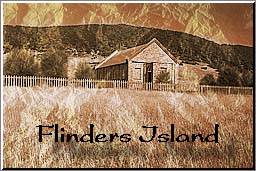 Between 1829 and 1834 the remnants of this once proud and peaceful
race were collected from all over the island and resettled in
a reserve on Flinders Island - to be 'civilized'
and Christianized. With nothing to do but exist, most of them
died of despair, homesickness, poor food or respiratory disease.
Of the 135 who came to the island, only 47 survivors were transferred
to Oyster Cove in 1837. It's hard to believe, but during those
first 35 yeas of European settlement, 183 Europeans and nearly
4000 Aborigines were killed.
Between 1829 and 1834 the remnants of this once proud and peaceful
race were collected from all over the island and resettled in
a reserve on Flinders Island - to be 'civilized'
and Christianized. With nothing to do but exist, most of them
died of despair, homesickness, poor food or respiratory disease.
Of the 135 who came to the island, only 47 survivors were transferred
to Oyster Cove in 1837. It's hard to believe, but during those
first 35 yeas of European settlement, 183 Europeans and nearly
4000 Aborigines were killed.
European sealers had been working in Bass Strait since 1798 and, although they occasionally raided tribes along the coast, on the whole their contact with the Aborigines was based on trade. Aboriginal women were also traded and many sealers settled down on the Bass Strait islands with these women and had families.
By 1847 a new Aboriginal community, with a lifestyle based on both Aboriginal and European ways, had emerged on the Furneaux group of islands, saving the Tasmanian Aborigine from total extinction. Today there are more than 65000 of their descendants still living in Tasmania and still fighting for their rights.

